Indian Student Visa: Step-by-Step Process for International Students (2027)

By Pratik Gandhi, Students' Admission, Edulab
(LinkedIn) | Last updated: May 6, 2026
Your Roadmap to an Indian Student Visa: What to Expect as an International Student
With admission letter in hand, the Indian Student Visa (S-1) is your legal entry ticket to studying in India. The Government of India issues it to anyone accepted into a recognized Indian institution (Indian Visa Online).
A few things to know upfront:
- The visa covers full-time academic programs only. No unauthorized employment (MHA India).
- Internships are possible, but only with explicit university approval.
- Validity runs up to 5 years, matched to your course length (Indian Visa Online).
- Nepali citizens can enter India freely without a visa. But they still need a university student permit and, as of 2025–26, must complete FRRO registration (Kodem Law) & SII portal registration.
Step-by-Step: The Complete Indian Student Visa Process (Steps 1–8 with Timeline)
I'll walk you through this exactly as I do with students in person. Work backwards from your intended start date. That's the only way this doesn't become a panic. How early and accurately you prepare your file is what determines your timeline.
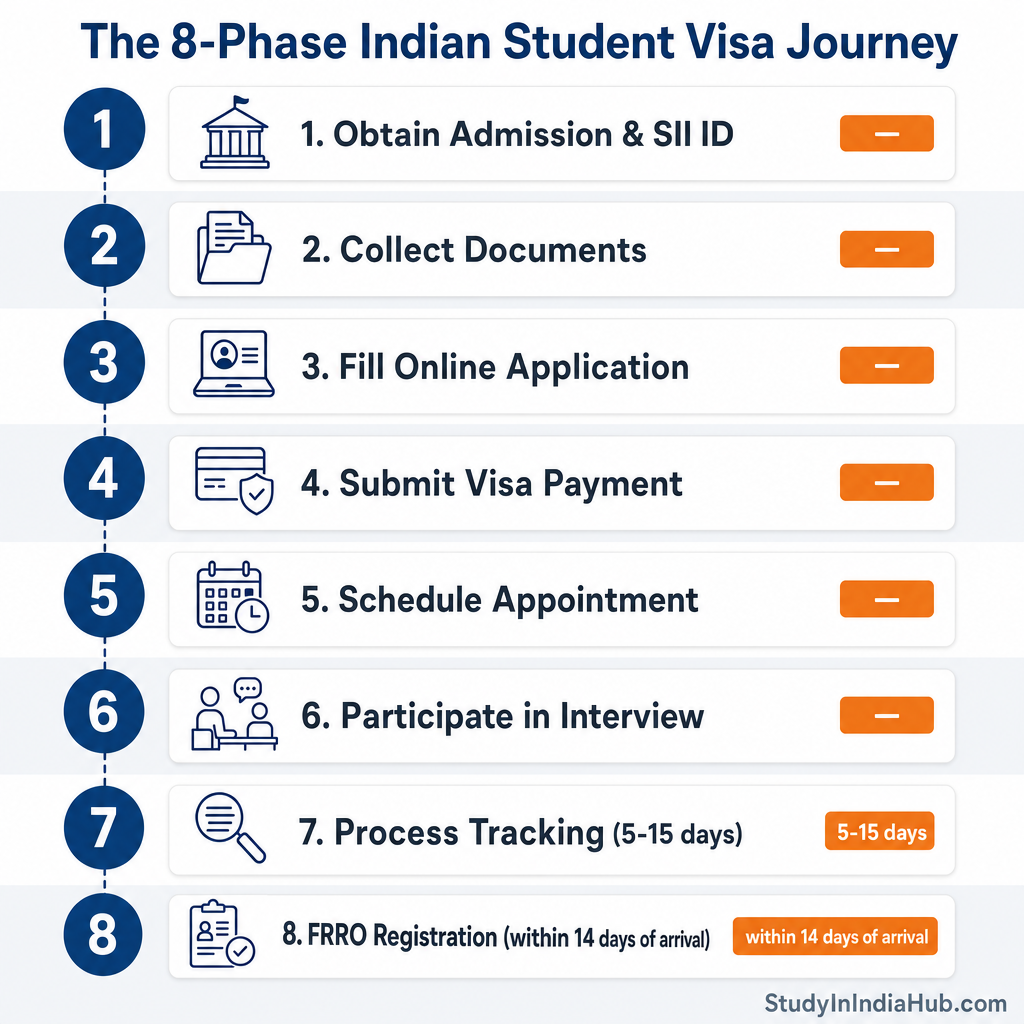
Step 1: Secure Your Admission & SII Registration
Timeline: 1–4 weeks before visa application
Your starting point is a formal, unconditional admission letter from a recognized Indian institution. It must be on the university letterhead. It must include your full name exactly as in your passport, plus course details, duration, and start date.
Visa validity matches your course length:
- 2 years for a Master's coursework program
- 4 years for undergraduate
- 3 years for research/PhD
- 5 years maximum (MHA India)
What the university does here: International offices of all major universities including IITs, IIMs, Delhi University, Mumbai University issue this letter and confirm your SII (Study In India) portal registration. SII is a compulsory ID that tracks your foreign student journey and fast-tracks your visa (Study in India Portal).
I've seen rejections happen because the admission letter said "Hassan Khan" and the passport said "Hassan M. Khan" Check every character before you accept the letter.
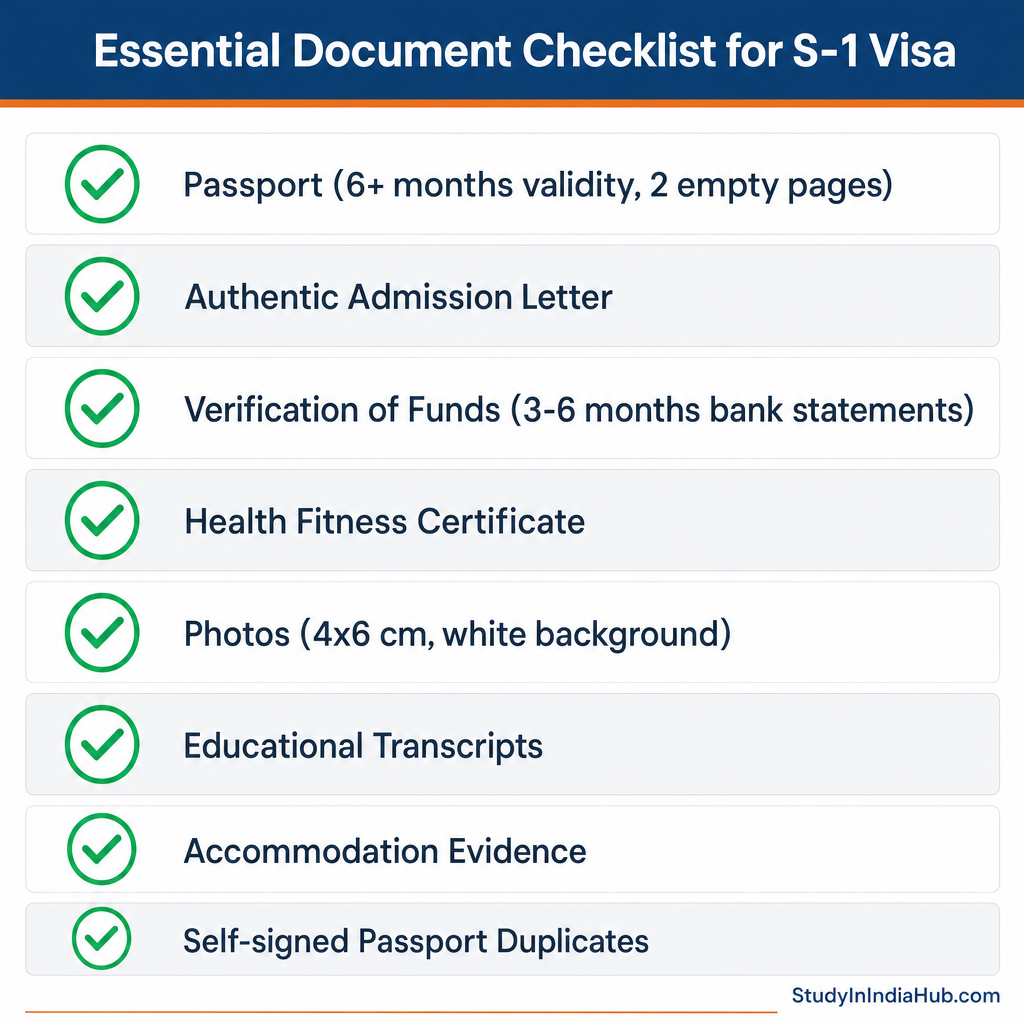
Step 2: Gather Your Complete Document Checklist
Timeline: 1–2 weeks before visa application
Core documents required:
- Valid passport with 6+ months validity and 2 blank pages
- Official admission letter (original or certified copy)
- Proof of funds — last 3–6 months of bank statements, scholarship letter, or sponsor affidavit
- Medical fitness certificate from an authorized physician
- Passport-size photos — 4×6 cm, white background, taken in the last 6 months
- Academic transcripts and prior education certificates
- Proof of accommodation — hostel allotment (by the university) or rental agreement
- self-attested photocopy of passport's first and last page
Step 3: Complete the Online S-1 Visa Application
Timeline: 1 week before your embassy appointment
Go to the Indian Visa Online portal and select Student Visa (S-1). Every name, date, and address must match your passport exactly.
The system generates an application reference number. Note it down as you'll need it for every step forward.
Step 4: Pay the Visa Fee & Book Your Appointment
Timeline: Immediately after submitting; appointment 3–5 days later
Pay the non-refundable fee through the portal and save your receipt. Then book your appointment immediately. Slots fill fast during peak intakes (June–August, December–January).
Plan for 2–6 weeks of wait time at busy embassies (Sri Lanka, Bangladesh, UAE).
Step 5: Attend the appoinment & Submit Documents
Timeline: On your appointment date
Arrive 15 minutes early.
Bring:
- Passport and printed application confirmation
- All originals (admission letter, bank statements, medical certificate, transcripts)
- Self-attested passport copies and photos
Special note for Nepali students: You don't need a student visa to enter India (MEA India). You can enter freely and only need SII registration before arrival and FRRO registration after arrival — see Step 8.
Step 6: Track Your Application & Processing Times
Timeline: 5–15 working days
After your interview, your passport enters processing. Here's what I've tracked:
| Country | Typical Processing Time | Source |
|---|---|---|
| Sri Lanka | 5–7 working days | HCI Colombo |
| Bangladesh | 5–7 working days | HCI Dhaka |
| UAE | 5–7 working days | CGI Dubai |
| Kuwait | 7–10 working days | Embassy of India, Kuwait |
| General | 5–15 working days | Indian Visa Online |
During July–August intake, expect the full 15 days. Track your status on the portal using your reference number. If it goes beyond 15 working days, contact your international office. They can sometimes escalate.
Step 7: Verify Visa & travel to India
Timeline: On your travel date
When your passport is returned, verify immediately. Name spelled correctly. Validity dates match course duration. Entry type shows "Multiple." If everything looks good, then book your travel to India.
Step 8: FRRO Registration — The Final Gate
Timeline: Within 14 days of arrival
This step catches students off guard as this is kind of unique to India. If your stay exceeds 180 days - and almost every student visa does — you must register on the e-FRRO portal within 14 days of arrival (MEA India FRRO Checklist). Any delay here can lead to late fees, penalties and legal complications when leaving the country (DocuPro).
How to register:
- Go to the e-FRRO Portal and create an account with your passport number
- Fill the form and upload: passport scan, visa, admission letter, 4 photos, bonafide certificate, proof of residence
- Submit — approval usually arrives within 24 hours via email
What the university does here: This is where a proactive international office matters most. Mumbai University, SPPU, Manipal, and Christ University provide the bonafide certificate (3 copies) and FRRO undertaking letter in your first week on campus. Get these documents the day you register at the university.
As of 2025–26, Nepali students must also complete FRRO registration despite not needing a visa (Kodem Law).
After FRRO registration, you can open an NRO Savings Account at SBI, HDFC, or ICICI using your visa and FRRO endorsement (RBI / DNA India, SBI).
Full Timeline: Work Backwards From Your Start Date
| Milestone | When to Complete | Time Required |
|---|---|---|
| Secure admission letter & SII registration | 10–12 weeks before start | 1–4 weeks |
| Gather all documents | 8–10 weeks before start | 1–2 weeks |
| Submit online visa application | 6–7 weeks before start | 1–2 days |
| Pay fee & book appointment | 6 weeks before start | Immediate |
| Attend visa appointment | 4–5 weeks before start | Appointment date |
| Receive visa | 2–4 weeks before start | 5–15 working days |
| Travel to India | 1–2 weeks before start | Travel date |
| FRRO registration | Within 14 days of arrival | 1–2 days |
Start gathering documents while you wait for the admission letter. Parallel processing saves weeks. And in this process, weeks are the difference between making your intake and missing it.
Country-Specific Visa Requirements & Easiest Routes
| Country | Visa Required? | Typical Fee | Processing | Key Advantage | Source |
|---|---|---|---|---|---|
| Nepal | No | $0 | N/A | NEB +2 = Indian 12th | MEA Treaty |
| Sri Lanka | Yes | $60–$120 | 5–7 days | GCE A/L recognized | HCI Colombo |
| Bangladesh | Yes | $13–$100 | 5–7 days | HSC recognized | HCI Dhaka |
| UAE | Yes | $80–$150 | 5–7 days | UAE SSC recognized | CGI Dubai |
| Kuwait | Yes | $80–$150 | 7–10 days | — | Embassy of India, Kuwait |
Nepal is the easiest case — Nepali citizens need no student visa at all (MEA Treaty of Peace and Friendship). The NEB +2 is recognized as equivalent to Indian 12th standard (AIU Equivalence Division). Both the travel and admission sides move faster than anywhere else.
For everyone else, "easy" depends on processing time and equivalency recognition. GCE A/L, HSC, and the UAE Secondary School Certificate are all recognized by AIU (AIU Equivalence Division). That prevents admission delays. What actually stalls files isn't the country — it's a name mismatch between passport and admission letter, or a slow international office.
How long does an Indian student visa take to process?
Standard processing is 5–15 working days (Indian Visa Online).
Across r/IndianStudents, Y-Axis forums, and Quora, two questions come up constantly:
- "Why is my e-visa still 'Under Process' after 10 days?"
- "Do I really need FRRO registration if I'm staying under 180 days?"
Short answers: delays past 10–15 working days usually trace back to incomplete bonafide letters or unclear funding proof, not backend issues. And yes — FRRO registration within 14 days is mandatory for any student visa valid over 180 days, no matter how long you actually stay.
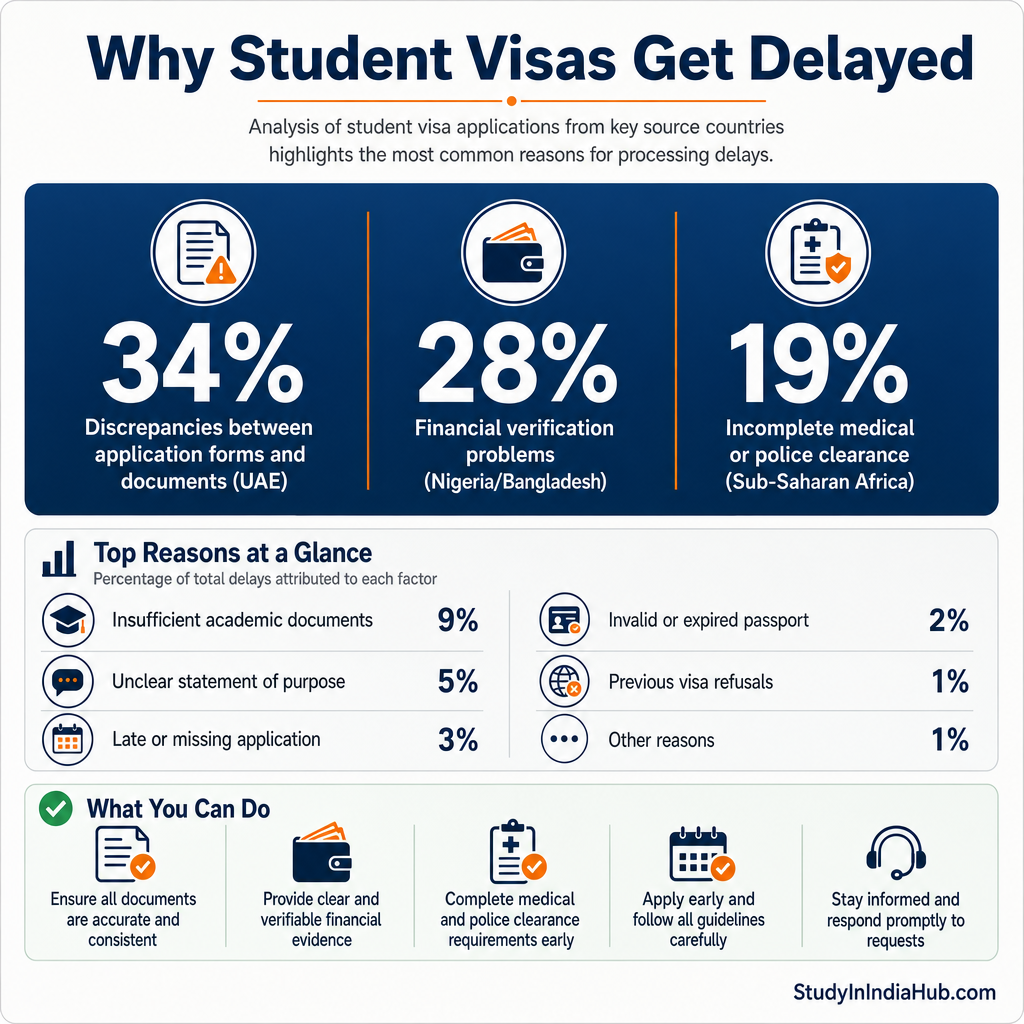
What Actually Causes Delays
- Name mismatches. If your passport says "Arthur John Smith" but your admission letter says "A. J. Smith," the embassy pauses your file. That's another 5–15 days while you chase a corrected bonafide letter.
- Incomplete financial documentation. Bank statements and sponsor letters must clearly cover your full course duration. Anything ambiguous triggers a clarification request.
- Slow university offices. Some respond in 48 hours. Others take two weeks.
- Surge periods. July–August and January intakes create bottlenecks across every mission at once.
Why Applications Get Rejected — and How to Fix It Before You Apply
Most rejections aren't about eligibility but about documents that don't line up, or details that quietly raise flags.
The Four Rejection Triggers
1. Incomplete or Mismatched Documents
A missing page. An unreadable scan. A name that doesn't match across passport, admission letter, and form.
Fix: Lay every document side by side. Verify name, date of birth, and passport number are identical across all materials including the way middle name is written.
2. Insufficient or Unclear Financial Proof
"My parents will support me" gets rejected. A bank statement showing ₹15 lakhs with a sponsor letter covering ₹8 lakh annual fees works. A recently opened account with a large unexplained deposit is a red flag.
Fix: Provide 6 months of bank statements showing a steady balance. If someone else funds you, include a notarized sponsor letter stating exact amount and duration.
3. Unclear Enrollment Proof
Your admission letter is your anchor. If it's conditional, vague about duration, or from an unrecognized institution, the application stalls. If you're applying through Study in India, confirm your institute is a recognized partner (Study in India Portal).
Fix: Your letter must be unconditional and final, with full name, course title, duration in months, and expected completion date.
4. Overstay or Prior Immigration Issues
I've seen students rejected for India visas because of a short overstay in a third country years earlier. ]
Fix: Include a written explanation with dates and supporting records. Show ties to your home country — property documents, family business records, or a return job offer.
Frequently Asked Questions
Can I work on a student visa in India?
No. Work is strictly prohibited (MHA India). What is allowed: internships that are part of your curriculum, with written university approval.
Can I extend my visa if my course runs longer?
Your visa is valid for course duration or 5 years, whichever is less (MHA India). If your course overruns, apply for an extension through the e-FRRO Portal before your stamp expires. Get an updated Bonafide Certificate from your university.
What happens if my visa expires before my course ends?
You're overstaying. That means fines, deportation, and a potential re-entry ban.
Can family members accompany me?
Yes. Your spouse and children can apply for an S-2 Dependent Visa (MHA India). They are prohibited from working in India. Requirements vary by embassy. Contact your nearest Indian mission before booking family flights.
Is a medical test mandatory?
Yes. A medical fitness certificate from an authorized physician is required (Indian Visa Online). Get it done before your appointment.
About the Author
Pratik Gandhi — Pratik is the founder of Edulab which is an LMS provider working with multiple universities in India to streamline their admissions process. His focus is the operational side: SII portal registration, embassy documentation, FRRO compliance, and the first three months on the ground.
Sources
- Indian Visa Online — Visa Instructions and Categories
- Ministry of Home Affairs — Visa Manual 2019
- e-FRRO Portal — Registration & Services
- MEA India — Treaty of Peace and Friendship (Nepal)
- MEA India — FRRO/FRO Registration Checklist
- AIU — Evaluation & Equivalence Division
- Study in India Portal — Scholarships & Fees
- High Commission of India, Colombo — Visa Services
- High Commission of India, Dhaka — Visa Services
- Consulate General of India, Dubai — Visa Services
- Embassy of India, Kuwait — Visa Services
- NAAC — Accreditation Results
- DocuPro — FRRO Registration in India: Complete 2026 Guide
- Kodem Law — FRRO Registration for Foreign Students
- RBI / DNA India — NRO Bank Account for Foreign Students
- Leverage Edu — Bank Accounts for International Students
- SBI — NRO Account for Non-Residents