Study in India for Nepali Students: Complete Guide 2027

Authored by Aarav Shrestha, a Nepali undergraduate studying in India, class of 2026. Composed in 2026 to assist applicants from Nepal in 2027.
Quick facts for Nepali students considering study in India: No visa required under the 1950 Treaty. Although registration of Study in India portal is mandatory. NEB +2 is recognized as equivalent to Indian Class 12. FRRO registration is mandatory within 14 days if you stay over 180 days. Annual tuition ranges from INR 4,800 to over INR 5,00,000.
How to choose a University
I doubt any single university suits all Nepali students. The ideal choice relies on community, hostel availability, and ease in the city, rather than solely on brand identity. Unless you are going for a top 10 ranked Indian university - IITs or IIMs or AIIMS.
My suggestion: select the city cluster initially, then identify the appropriate university within it that fits your program and financial plan. Because a lot of your experience in India will depend on the city you live in including airport / train for travelling back home, food and access to other Nepali students. For most international students, there are three clusters to choose from:Mumbai–Pune area, Bangalore or Delhi-NCR. These cities boast the most well-established Nepali student communities, vibrant Facebook groups, cultural organizations, and Dashain/Tihar festivities organized by seniors who are familiar with the city.
I met a student here at Mumbai University who initially went to another university in a tier-II city but then switched to Mumbai University due to the absence of a Nepali community & lack of familiar food. Metro cities such as Delhi, Mumbai have a big community with a lot of options.
Here's what to evaluate when comparing University options:
| Factor | Why It Matters for Nepali Students |
|---|---|
| Nepali student community | Faster settling, practical help in month one |
| Hostel availability | Removes private-rent pressure; verify directly with admissions |
| Recognition back home | Critical if you plan to work or study further in Nepal |
| Proximity to border/airport | Pune/Mumbai flights from KTM ~3.5 hrs, ~$180; North India suits border-city students |
| SAARC fee treatment | Some universities list lower SAARC fees (CUHP) — ask for written confirmation |
| NAAC accreditation | A NAAC-accredited 'A' grade or higher means quality oversight (NAAC) |
| Scholarship access | ICCR A2A had 630 slots in recent cycles |
The Application
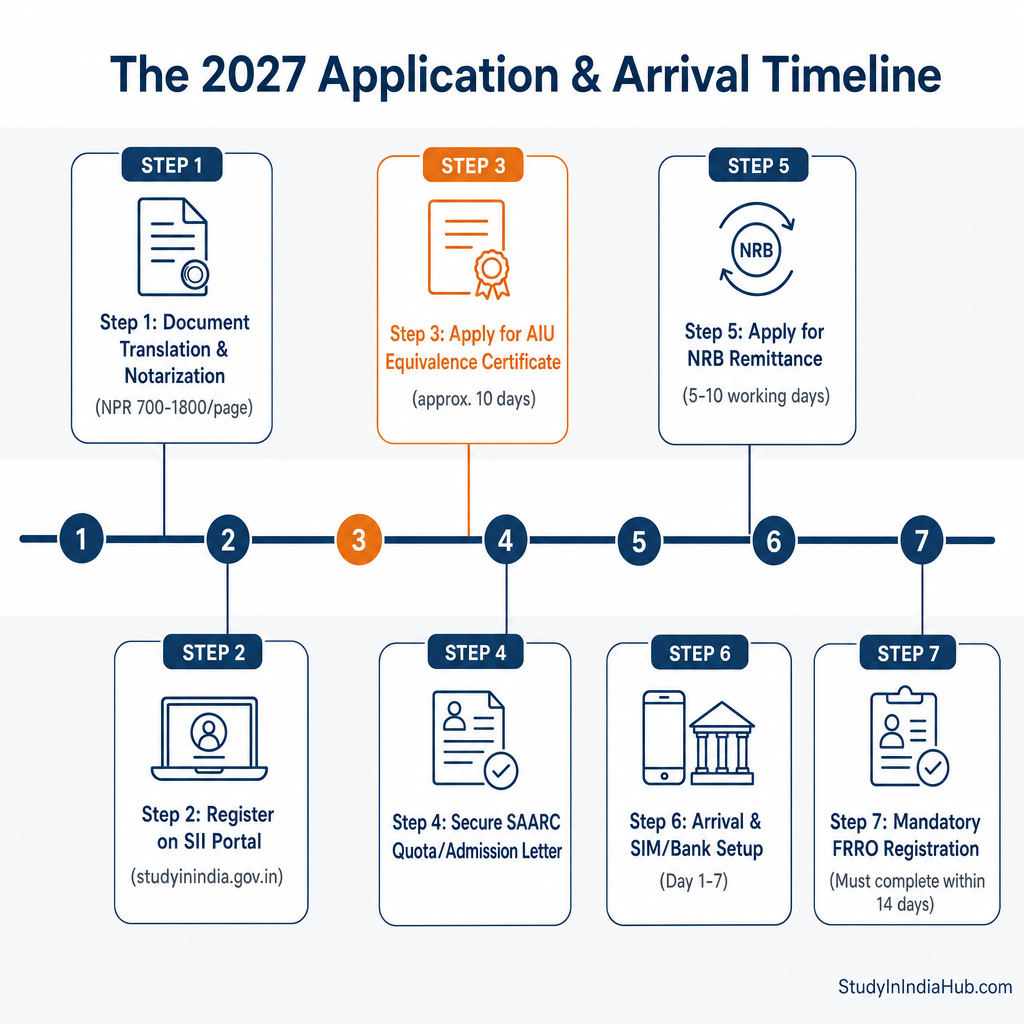
Step 1: Register on the SII Portal
Register for your account at studyinindia.gov.in. Complete all information using your legal name precisely as it is shown on your citizenship certificate.
Step 2: Submit Your NEB Transcript, and Ensure Accuracy From the Start The portal needs a transcript in English. In case you do not have it in English, find a certified translator in Kathmandu, have it notarized, and resubmit.
Current 2026 rates:
- Translation of NEB marksheet/transcript along with notary: NPR 700–1,400 for each page (TranslationsCertified)- Academic transcripts : NPR 700–1,800 for each page in reality- Standard personal documents in Kathmandu: NPR 400–1,500 each page for translation + NPR 100–300 for each document for notarization- Have your transcript translated and certified prior to opening the portal.
Step 3: The AIU Equivalency Certificate
This is the stage that many Nepali students completely overlook. Indian universities require evidence that your NEB +2 is comparable to Indian Class 12. The AIU Equivalence Division officially acknowledges this; however, you must personally apply for the certificate. It takes about 10 days, and you'll receive a PDF via email. Produce a printout of it.
Step 4: Inquire about SAARC Quota
Majority of universities do not publicize SAARC seats on their websites. You need to directly email the international admissions office and inquire: "Are there SAARC quota seats available for Nepali nationals, and what is the fee structure?" This can not only make your admission easier but also make your fees lesser.
Step 5: Research and Apply to Indian universities
Majority of the universities have a standard process for application. I preferred direct admission than via going through a consultant. Not only is the direct route is easier but also in your best interest. Consultants often get kickbacks from universities so they tend to recommend universities which give them higher commission irrespective of the university's ranking
Step 6: Receive admit, collect invitation letter
Once you receive an admit from the universities, decide which university you want to go to finally. Once finalised, pay the admission fees and ask their admissions office / international student cell for your invitation letter clearly mentioning your name, course and duration. This will be needed when you enter India.
That's it. Once you have the admit, you should plan to come to India as there is no Visa requirement for Nepali citizens.
Getting There: Kathmandu to Campus
The Flight Route
There are as many as 70 flights per week from Kathmandu to key Indian cities, operated by Air India, IndiGo, Nepal Airlines, and SpiceJet. Nonstop flights to Delhi typically take 1 hour 45 minutes to 2 hours 5 minutes (Trip.com). If your university is located in Delhi, Mumbai, or Bangalore, you can take a direct flight.
The Border Route
The land route through Sunauli or Birgunj costs less initially, approximately NPR 500–1,500 for the bus. However, based on your university's location, you will have to take another train, bus or flight to reach the university. Based on the destination, you can choose what works best for you.
Your First Week
- SIM card Without an Indian number, you won't be able to order a rickshaw, get OTPs, or reach your hostel. Take your passport and a printed address of the hostel. The procedure requires approximately 30 minutes.
- Bank account Your university requires it for tuition payments and reimbursements. Visit HDFC or SBI close to your hostel with your admission letter and hostel allotment as evidence of your local address.
- Hostel deposit Numerous Indian ATMs impose low daily withdrawal limits for Nepali cards. Bring sufficient INR to manage at least the initial deposit.
FRRO Registration: Important step
Even if we do not need a Student Visa to enter India, we are still required to complete FRRO registration to undertake our studies in India.
Anyone whose course lasts longer than six months is required to register with the FRRO. Missing the 14-day deadline can lead to issues such as penalties, late fees or worse deportation. Pursue your university's international office as soon as you arrive.The e-FRRO procedure can be completed online through the e-FRRO portal.
Here’s the precise sequence:
- Register an account on the e-FRRO portal
- Complete the application by providing your passport information, admission details, and local address.
- Submit documents: passport, acceptance letter, Bona Fide Certificate, address proof, and passport-sized photo, etc
- Send and monitor, approval typically arrives by email as a Registration Certificate (RC). A solution I learned from the WhatsApp group: bring the hostel allotment letter from the college on official letterhead, along with a signed copy of the warden's identification. Multiple students indicated that this resolved their registration with one upload. Certain sources indicate that Nepali students might be "typically exempt" but avoid taking chances on that. The process is free and quick.
Money Matters: Fees, NRB Limits, and Scholarships That Are Actually Real
Tuition Fees
Tuition costs for Nepali students studying in India vary between INR 4,800 to INR 5,00,000 annually. Monthly living expenses increase by an additional INR 5,000 to INR 10,000+ (Mumbai cost data; Pune cost data).
Here’s the actual cost scenario, adjusted at approximately 1 INR = 1.6 NPR:
| University (Example) | Course | Annual Fee (INR) | Approx. Annual Fee (NPR) |
|---|---|---|---|
| Delhi University | B. A. | ₹4,800 – ₹21,000 | ~₹7,700 – ₹33,600 |
| Mumbai University | B. A | ₹40,000 – ₹1,80,000 | ~₹64,000 – ₹2,88,000 |
| IIT Bombay | B. Tech | ₹3,23,350 | ~₹5,17,360 |
| Private University | B. Tech | ₹150,000 – ₹2,50,000 | ~₹230,000 – ₹4,00,000 |
Certain universities provide a SAARC student rate that is lower than the complete international fee. You should definitely look into it when researching into universities.
Sending Money from Nepal
The Nepal Rastra Bank (NRB) allows educational remittance, but it's not done automatically. You must obtain your official admission letter and apply through your bank. Branch officers I interacted with mentioned that processing usually requires 5–10 working days after the admission letter, fee invoice, and passport copies are submitted correctly. Delays often arise from insufficient documentation instead of the NRB review process itself. Begin discussions with your bank as soon as you receive your provisional admission letter. Confirm present limits with your remitting bank prior to each transfer, as updates to circulars occur regularly. What was effective for me: the initial enrollment fee was transferred directly from Nepal to the university account via bank transfer, slow but legitimate. For monthly living costs, use a forex card funded in INR from Nepal, then local UPI applications for everyday expenditures.
Scholarships: What's Real vs. What's Marketing
| Scholarship | Slots / Year | Funding Level |
|---|---|---|
| ICCR A2A (Africa–Asia) | ~630 (2022–23) | Fully funded |
| Study in India (SII) Scheme | Varies by partner | Partial to full |
| Sushma Swaraj Silver Jubilee | ~100 | Fully funded |
| SAARC concession (institutional) | Varies | Fee reduction only |
The ICCR A2A and Study in India scholarships are truly completely funded, yet the competition is fierce. Sri Lanka received approaching 4,000 applications for only 200 positions in the 2026–27 cycle (Jaffna Monitor). The same pressure is relevant to Nepal.
What I truly got: the SAARC discount rate, not a complete scholarship. That remains significantly less expensive than the typical international fee, but it wasn't the "full scholarship" I had come across on Facebook. If your family is planning financially based on a scholarship you haven't received yet, that's a gamble.
Sources
- 1950 Treaty of Peace and Friendship
- AIU Equivalence Division
- Study in India portal
- jointly launched by India's Ministry of Education, Ministry of External Affairs, and Ministry of Home Affairs on 3 August 2023
- 30,000 international students
- about 28% of the total 46,878 foreign students from 170 countries enrolled across Indian universities in 2022
- ~14,000 international students from 102+ countries
- ICCR
- UGC
- SPPU International Centre
- CUHP
- NAAC
- studyinindia.gov.in
- TranslationsCertified
- TranslationShop
- India Today / BestColleges
- Trip.com
- Mumbai cost data
- Pune cost data
- Jaffna Monitor