Why Nepali Students Choose India Over Other Countries (2026)

Why India Is the Default Choice for Nepali Students
India operates the second-largest education system globally, featuring over 800 universities with programs include medicine, engineering, management, and hospitality (NEP 2020), and attract almost ~46K international students every year. Approximately 28% of the 46,878 international students from 170 nations who entered Indian universities in 2022 were from Nepal (AIU), and it shows how India is one of the most sought after education destinations for Nepali students.
And there are four primary reasons for this in my view
- Ease of travel and lack of visa requirement
- Affordable expenses in terms of tuition fees and cost of living
- Cultural proximity in terms of culture, language, religion
- Ease of qualifications transfer to Home country
No Visa, No Barrier
The Visa-Free Reality
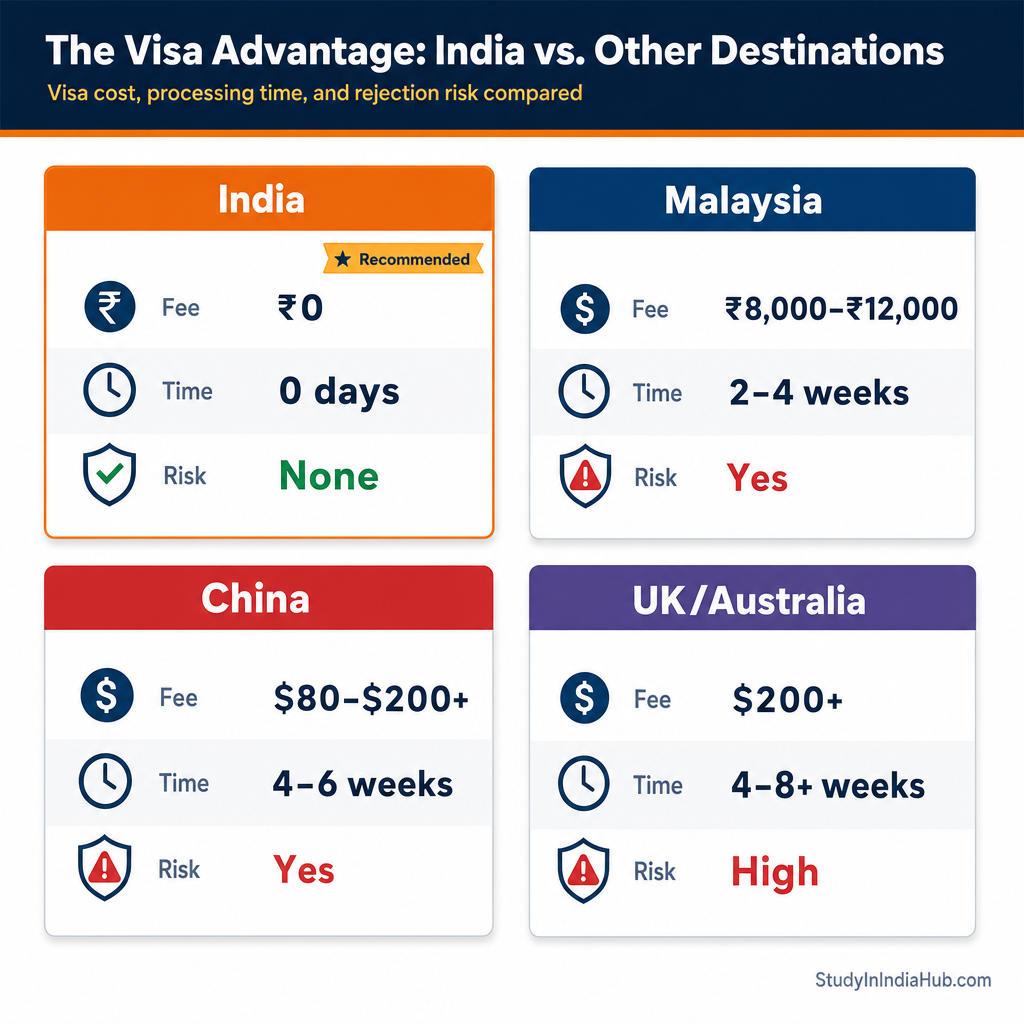
A student from Nepal can enter India without needing a visa due to the 1950 Treaty of Peace and Friendship (MEA India). Essentially, you can register at a university and begin courses in a few weeks. On the other hand, students seeking entry to Malaysia, Bangladesh, or China will encounter visa costs, wait times, and the possibility of denial.
Additionally, travel between the two countries is also short and direct. Flights from Kathmandu to Delhi last 1 hour 45 minutes to 2 hours 5 minutes. Air India, IndiGo, Nepal Airlines, and SpiceJet operate as many as 70 weekly flights.
Compare that with every other option and none of them come close.
| Destination | Visa Fee | Processing Time | Rejection Risk |
|---|---|---|---|
| India (Nepali citizens) | ₹0 / $0 | 0 days | None |
| Malaysia | ₹8,000–₹12,000 (~$95–145) | 2–4 weeks | Yes — financial doc thresholds |
| China | $80–$200+ | 4–6 weeks (X visa + invitation letter) | Yes |
| Bangladesh | Similar to Malaysia | 2–4 weeks | Yes |
| UK / Australia | $200+ | 4–8+ weeks | Yes — high rejection rates |
The Real Cost Comparison: India vs. Other Options
The second reason is total cost of education which includes the cost of living in India is affordable for Nepali families. Not just that, India offers more than just lower tuition costs and cost of living. Travel costs are also lower for flights and urgent trips. Remittance costs are also lower. These costs look small but compound over 4 years. Hence, it matters when you are calculating your total cost of education in India.

4-year total cost snapshot:
| Country | 4-Year Total (USD) | Annual Tuition (USD) | Annual Living Cost (USD) | Key Cost Factors |
|---|---|---|---|---|
| India | $8,000–$25,000 | $500–$6,000 | $1,500–$3,000 | No visa fees. KTM→Delhi ~$180 return. Remittances: 1–2% fee. |
| Malaysia | $32,000–$48,000 | $3,000–$7,000 | $4,000–$6,000 | Visa fee ~$80. KTM→KUL ~$400–$600 return. Remittances: 3–4%. |
| China | $16,000–$24,000 | $3,000–$10,000 | $2,500–$4,500 | Visa fee ~$140. KTM→Shanghai ~$500–$800 return. Mandarin barrier. |
| Bangladesh | $15,000–$25,000 | $2,000–$5,000 | $1,800–$3,000 | Visa required. Limited direct flights from Kathmandu. |
Indian tuition by course (international students):
| Course | Annual Tuition (INR) |
|---|---|
| BA/B. Com — Delhi University | ₹4,800–₹21,000 |
| B. Tech — Mumbai University | ₹60,000–₹7,70,000 |
| MBA — Mumbai University | ₹42,600–₹8,40,000 |
| B. Tech — SPPU (Pune) | ₹40,000–₹1,80,000 |
| MBA — SPPU (Pune) | ₹50,000–₹2,50,000 |
| B. Tech — IIT Bombay | ₹3,23,350 |
Do note that India isn't consistently inexpensive. IIT Bombay and leading private universities can be quite expensive. However, the affordable entry point for state universities such as Mumbai University is also real.
The flight and remittance gap compounds over four years.
A student in either Malaysia or China invests $800–$1,600 annually on flights to their home country. In a span of four years, that amounts to $3,200–$6,400 in additional travel expenses. None of it appears in a tuition comparison. Fees for transferring money from India to Nepal range from 1–2%. From Malaysia to Nepal? 3–4%. For a family transferring NPR 50,000 each semester, the individual transaction difference may seem minor but significant over eight semesters.
Cultural and Linguistic Proximity
The third reason which is often unsaid because it cannot be quantified is cultural and linguistic proximity. Students we've collaborated with find comfort in everyday life within 1–2 weeks of arriving in India. This is not a small feat. Adjustment after going to a completely new place can often take months and I am being conservative here. Students who are not from Asia usually require 3-4 months to adjust to the climate and social rhythm of the country. That's almost an entire semester of academic concentration that students going to Malaysia or China do not experience.
Language and Daily Life
Hindi and Nepali can be understood by speakers at a functional level. So, a Nepali speaker can engage in market discussions, comprehend Hindi news, and manage documents independently which helps with the adjustment. None of that holds true in Mandarin, Malay, or entirely English-speaking settings.
Cultural Calendar and Food
The common Hindu/Buddhist calendar is also important. Dashain, Tihar, Diwali, and Holi are celebrated in almost all Indian universities. Most colleges shut down for these celebrations. This gives the students an opportunity to experience festivities away from home. Even, food you get in most Indian universities is similar to a Nepali cuisine. Dal, rice, veggies, and spices are pretty common in hostel diets.
Education Quality and Degree Recognition
The belief that "lower cost equates to inferior quality" collapses as soon as you distinguish elite from average institutions. The recognition framework is also already established for Nepali students. Based on our experience assisting Nepali applicants, the NEB +2 equivalency via the Association of Indian Universities (AIU) is the usual route (AIU Equivalence Division). Admissions offices at central institutions regard an AIU equivalency certificate as equivalent to CBSE Class 12 results. Nepali candidates for IIT and AIIMS go through the foreign national category or take entrance exams such as JEE and NEET. Acceptance rates remain low, generally below 2% for leading IITs. However, the framework for recognition is clearly defined and open.
Even back home, the degrees are well recognised as covered in the India-Nepal Education Treaty. The treaty covers professional licensing for all major degree programs:
- Medical: Graduates with an MBBS from AICTE-approved institutions are eligible to take the medical licensing exam (NMC) in Nepal. Once cleared, they can practice medicine in Nepal
- Engineering: Students who graduate from AICTE-approved institutes are eligible to register as professional engineers in Nepal. IIT and NIT qualifications are widely regarded as the best in the Nepali job market Malaysian or Chinese qualifications do not receive this mutual recognition without additional equivalency procedures.
Popular Courses and Cities Nepali Students Actually Choose
MBBS, B. Tech, BBA/MBA, and nursing are the programs that Nepali candidates tend to crowd around. All degrees are acknowledged for obtaining licenses in Nepal.
Top Courses
| Course | Key Institutions | Annual Tuition (International) |
|---|---|---|
| MBBS | AIIMS Delhi, state medical colleges | ₹25,000–₹5,00,000 |
| B. Tech | IITs, NITs, SPPU, MU, DU | ₹40,000–₹3,23,350 |
| MBA | IIM Ahmedabad, Mumbai University | ₹42,600–₹8 |