Study in India for Sri Lankan Students: Admissions, Fees & Visa (2027)

By XYZ, Senior International Admissions Advisor | Last updated: May 11, 2026
Can Sri Lankan students study in India?
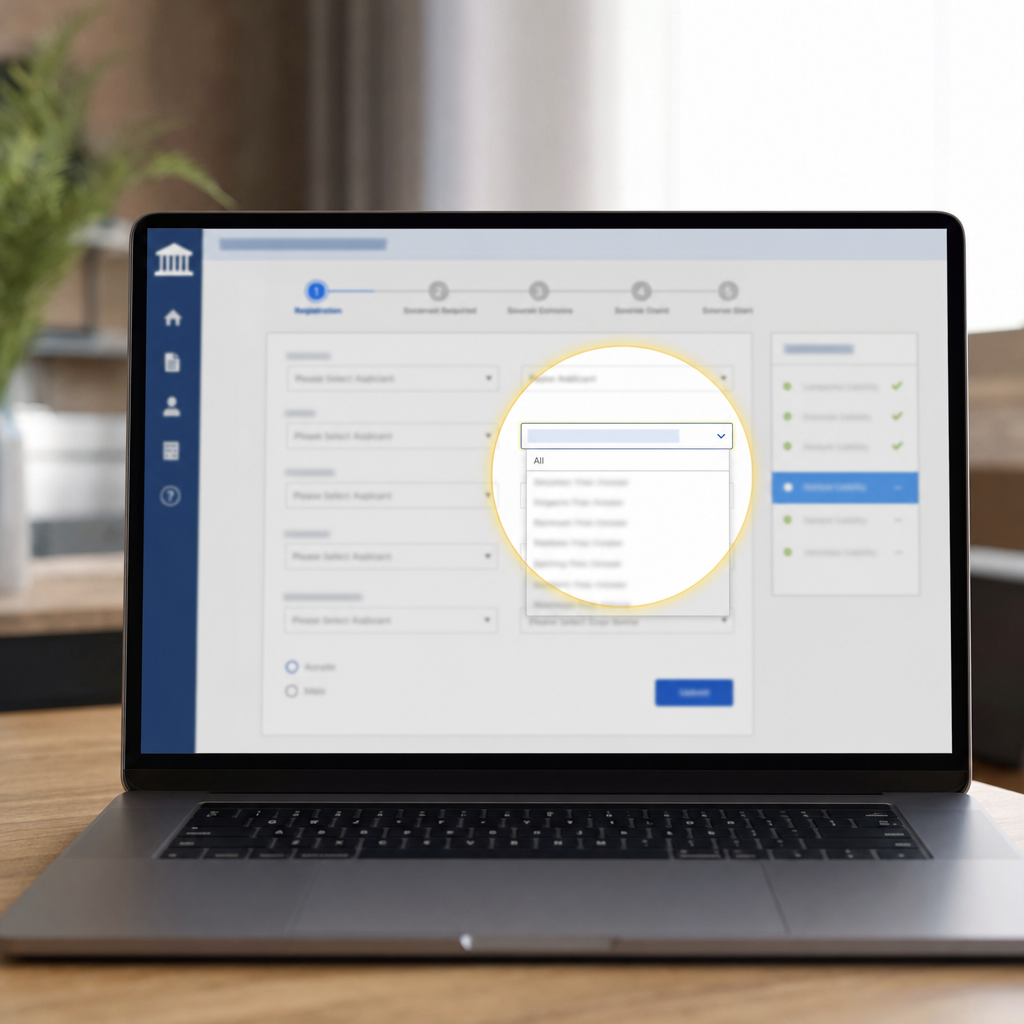
Yes. And in greater quantities than many people understand. Currently, more than 8,000 Sri Lankans are studying in Indian campuses. Here’s what many families overlook: you are not regarded as a completely "international" student. Sri Lankans are eligible for SAARC quota seats, designated places in standard programs at central universities such as Delhi University, Mumbai University and BHU. Many families discover this only after they are well into the process, resulting in them losing the discount completely. Your GCE A/L results are recognized as comparable to the Indian 12th standard (AIU Equivalence Division). Hence, you can apply straight to bachelor's degree programs in India. The primary access point for the government is the Study in India (SII) portal. It was launched on 3 August 2023 by the Ministries of Education, External Affairs, and Home Affairs (Study in India). Sign up there first and investigate universities and courses. Apply directly to universities and gather offer letters. Next, proceed to the student visa and FRRO process.
When researching for this
- Go to the High Commission of India in Colombo for the current regulations
- The SII website for the official application pathway
- University websites for information on specific courses.
The two formal routes for admission:
-
SII Portal, Signing up provides you with an SII ID. That serves as the entry point for the majority of university applications. Apply to universities directly shortlisted from here
-
DASA Program, for engineering at NITs, IIITs, or centrally funded technical institutes. Utilizes SAT Subject Test scores or JEE Main rank. If you miss the enrollment period, you forfeit an entire cycle (dasanit.org).
-
Regarding Colombo agents: numerous ones impose high fees simply to send documents that you could upload on your own. I've witnessed candidates pay for "assistance" only to fill out the same forms again because no one reviewed the specifics. That's a tax for convenience, not a recommendation.Refer to official websites for accurate information, student organizations for real-life insights, and consult agents only if you genuinely require assistance.
GCE A/L equivalency and the SAARC admission advantage
Your GCE A/L results, with at least three subjects, allow you to apply for undergraduate programs without needing any additional qualifications. However, India operates with percentage totals and we operate in A, B, C categories. So, it is better to get an AIU equivalency certificate. Some universities need it, others don't. But, better to get it made in advance.
The SAARC fee advantage
Being a Sri Lankan, you're not vying within the broader global arena. The fee disparity is considerable, approximately 40–50% lower than typical international fees at universities such as Mumbai University and Banaras Hindu University.
| Category | Seat Type | Fee Level |
|---|---|---|
| Sri Lankan (SAARC) | Reserved SAARC quota | Substantially reduced |
| General International | Open competitive pool | Full international rate |
The number of seats in SAARC is restricted. They aren't offered at all universities or in every course. Visit the designated institution's website. Also, actively choose the SAARC quota option during your application. It isn't a default in applications
How the application actually works
- Sign up on the SII portal. Set up your account long ahead of the deadline.
- Investigate courses. Narrow down to institutions that provide SAARC quota seats in your area of study.
- Submit your application. Attach your AIU equivalency certificate, A/L mark sheets, copy of your passport, and evidence of your Sri Lankan address. Scans need to be in color and high quality if specified.
- Get your offer letter. The processing time typically lasts 3–4 weeks. This letter is required for your application for a student visa. One detail that no one brought up: when applying for medical or paramedical courses, certain universities ask for a No Objection Certificate from the Ministry of Health in Sri Lanka. Initiate that process ahead of time. It may require weeks on its own.
ICCR Scholarship: worth applying alongside admission
If the exchange rate is causing you sleepless nights, consider the ICCR Scholarship Programme. The A2A portal for the 2026–27 cycle was accessible from 27 February to 22 April 2026. It includes expenses for tuition and living for undergraduate, postgraduate, and doctoral programs. It’s tough, but I know two classmates from Kandy who succeeded. Submit your application simultaneously with your standard admission, not afterward.
What is the visa process for Sri Lankan students?
Sri Lankan students require a Student Visa (S-1) to pursue studies in India. In contrast to Nepali students, we lack visa-free travel rights. The procedure is conducted via the Indian High Commission in Colombo (or the Assistant High Commissions located in Kandy, Jaffna, or Hambantota). Here's the aspect that astonishes the majority: an interview does not exist. Officials check your documents, stamp your passport, and you’re finished (HCI Colombo). There were no questions - the whole exchange involved passing a folder.
Documents you'll need
Bring originals and two photocopies of each:
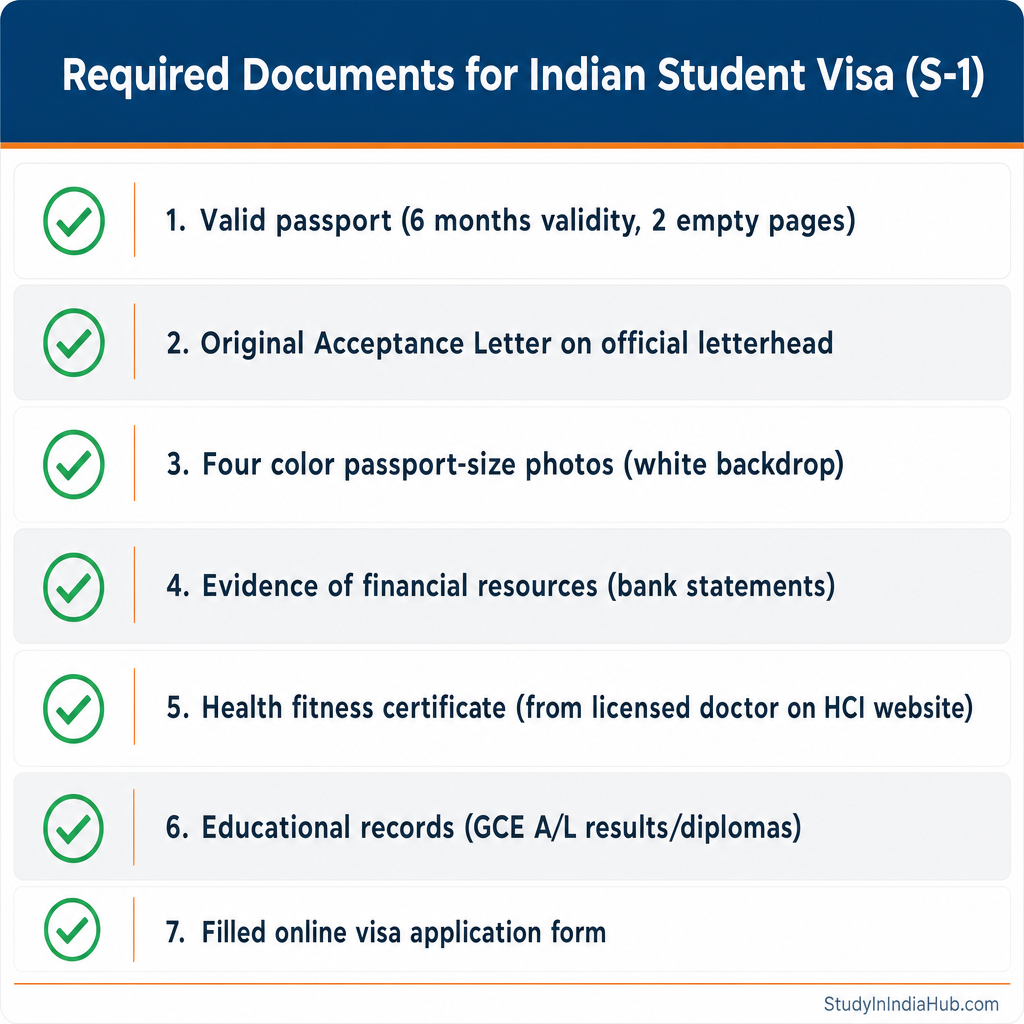
- Valid passport, minimum 6 months of validity, 2 empty pages
- Acceptance letter, original, printed on official letterhead with a registration number
- Four color passport-size photos, white backdrop, exact specifications
- Evidence of financial resources, bank statements showing tuition and living expenses
- Health fitness certificate, from a licensed doctor registered on the HCI website
- Educational records, GCE A/L results and diplomas
- Filled online visa application form, submitted through Indian Visa Online.
Timeline and fee
| Detail | What to Know |
|---|---|
| Visa Type | Student Visa (S-1) |
| Validity | Course duration or 5 years, whichever is less (MHA India) |
| Processing Time | 5–7 working days standard; up to 15 days in July–August |
| Interview | None — document verification only |
| Fee | Paid in LKR at the counter; check HCI Colombo for current rate |
Submit your application at least 6 weeks prior to your travel date. If you apply in July or August, you'll be in competition with all other students beginning the same term. A last verification before departing: ensure your visa duration aligns with your full degree term, 4 years for bachelor's, 2 years for master's. A legitimate certificate that fails to specify your course completion date can result in a shorter visa duration than required.
FRRO registration: the step everyone forgets until day 13
The guideline is clear: Once you have landed in India and if your student visa is valid for more than 180 days (which is likely the case), you are required to register within 14 days of landing (MEA India). Miss that deadline and a late fee of around USD 30 applies. Luckily, the process is completely online through the e-FRRO portal. It requires roughly 20 minutes and is completed in 24 hours. No appointment required unless they explicitly request your presence (DocuPro 2026 guide).
My walkthrough:
- Register for an account at indianfrro.gov.in
- Choose "Registration" and provide passport, visa, and Indian address information.
- Submit your documents
- Send, verification received in 24 hours
What to have ready before you log in:
- Scans of the passport (biographical information page + visa page + entry stamp)
- 4 digital passport-sized photos
- Acceptance letter from your school
- Bonafide certificate from your university - different from acceptance letter
- Verification of Indian address (hostel allocation letter, lease agreement, or utility statement)
How much does it cost to study in India from Sri Lanka?
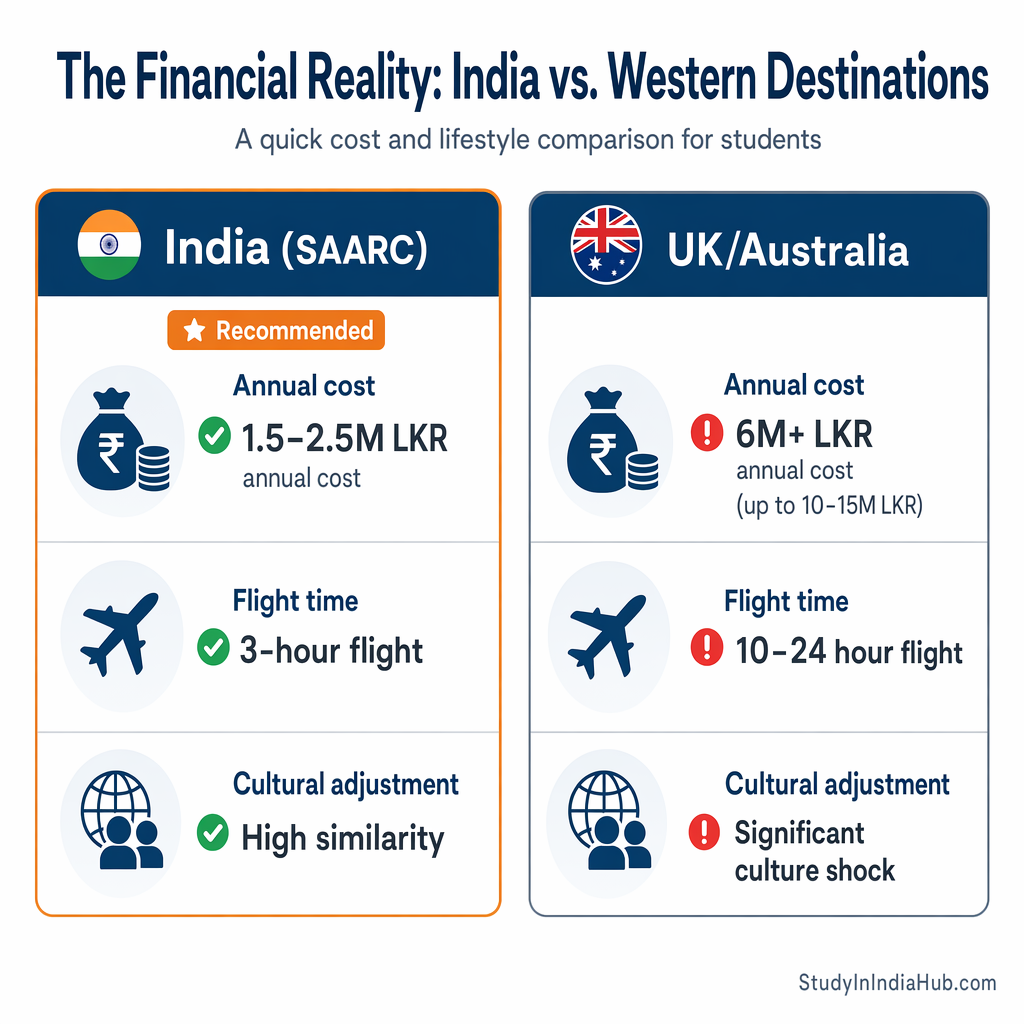
The concise response: INR 50,000–8,00,000 annually for tuition fees, along with INR 15,000–40,000 monthly for living expenses. However, those ranges conceal the true narrative. The amount you truly pay is determined by whether you secure a SAARC quota spot and the city where your university is located. Transform all INR amounts to LKR on the day of payment, rather than at the time of application.
Families that secure forward rates or make early remittances in larger amounts experience reduced currency fluctuation.
Tuition and living costs by city tier
| Cost Component | Tier 1 City (Mumbai, Bangalore, Delhi) | Tier 2 City (Pune, Mysuru, Coimbatore) | Notes |
|---|---|---|---|
| Tuition — SAARC Rate | INR 50,000–1,50,000/yr | INR 50,000–1,50,000/yr | I pay INR 85,000 at a Tier 2 university |
| Tuition — General International | INR 3,00,000–8,00,000+/yr | INR 2,00,000–5,00,000+/yr | The gap vs. SAARC rate can be 10× |
| University Hostel (incl. food) | ~INR 15,000–18,000/month | ~INR 8,000–10,000/month | I pay INR 8,500 in Mysuru |
| Private Accommodation | INR 20,000+/month | INR 8,000–12,000/month | Rent only — add INR 4,000–10,000 for food |
| Food (canteen/cooking) | INR 6,000–10,000/month | INR 4,000–7,000/month | Eating out in metros adds up |
| Transport, SIM, incidentals | INR 5,000–10,000/month | INR 3,000–7,000/month | Auto-rickshaws drain wallets |
| One-time setup costs | INR 25,000–40,000 | INR 20,000–30,000 | Visa, flight, hostel deposit, bedding |
Living cost estimates for specific cities can be found for Mumbai, Pune, Delhi, and Bangalore. Your yearly total expense falls between INR 3,30,000–8,40,000 based on your selections.
CBSL remittance limits and how my family moved money
Following the 2022 economic crisis, the Central Bank of Sri Lanka restricted outward remittances. The reported official student stipend is USD 30,000 annually (check at cbsl.gov.lk). The constraint isn't the yearly cap; it's the authorization procedure. Your Colombo bank will request your admission letter, visa, university fee structure, and proof of purpose. Begin this documentation as soon as you receive your offer letter.
Here's what actually worked for my family:
- Wise, Amma sent the money straight to my bank account in India. The rate surpassed the bank. For a ₹2,00,000 transfer, they saved about LKR 8,000–10,000 compared to a bank wire.
- Demand drafts, Utilized for the first tuition installment when the university necessitated a tangible document.
Sources
- NEP 2020
- ₹6,00,000 to ₹25,00,000+ depending on the college
- Study in India Portal
- AIU Equivalence Division
- Study in India
- Indian High Commission in Colombo
- dasanit.org
- Indian Visa Online
- MHA India
- MEA India
- Kodem Law
- e-FRRO portal
- DocuPro 2026 guide
- Mumbai
- Pune
- Delhi
- Bangalore
- verify at cbsl.gov.lk
- RBI / DNA India
- SBI
- Leverage Edu / RBI Guidelines
- intcent.unipune.ac.in