Study in India for Students from UAE & Kuwait: Complete Guide for NRIs 2027

CBSE, IB, and British A-Levels: Getting Your Qualifications Recognized
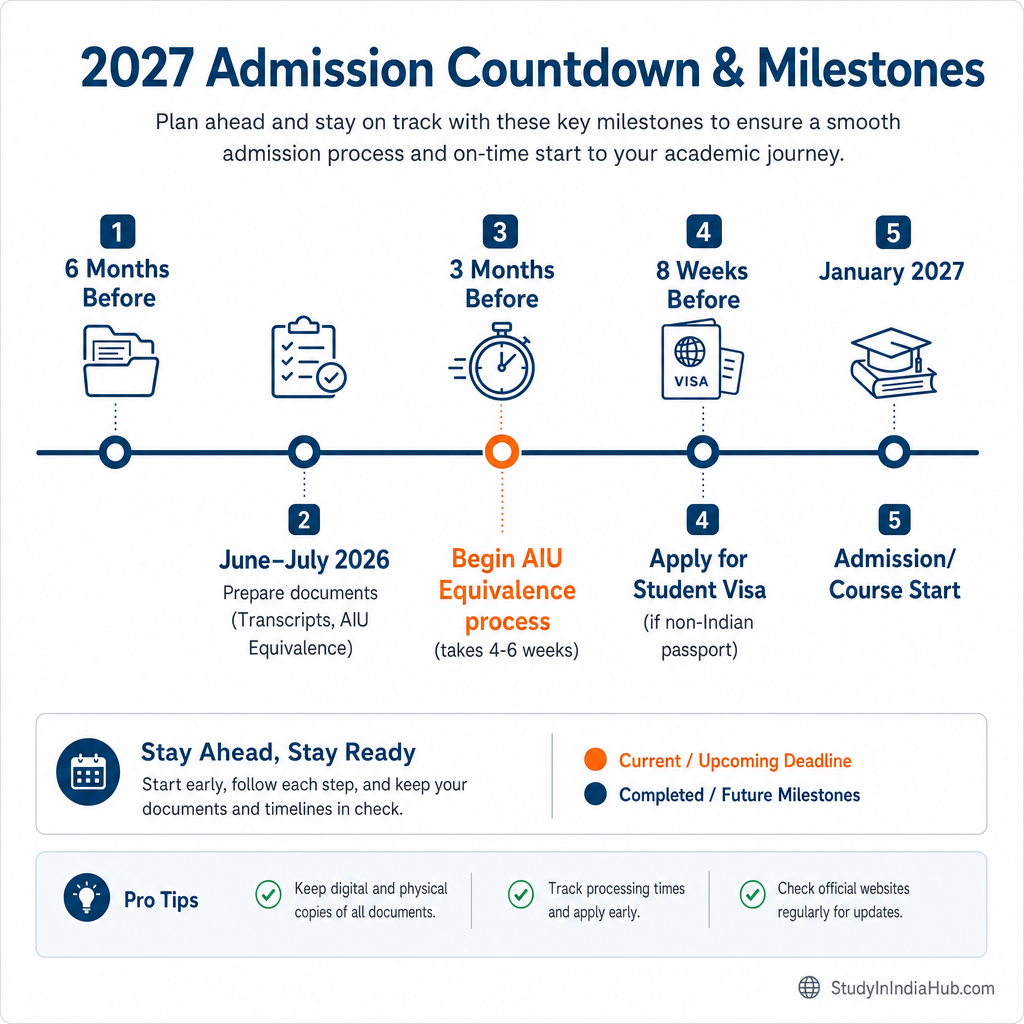
Having studied at GEMS, DPS, JSS, or Indian High School Dubai gives you a head start as Indian universities recognize CBSE and ICSE qualifications directly. So, your 12th standard marks feed straight into the application. However,if you hold an IB Diploma or British A-Levels, you need to get an equivalency certificate from the Association of Indian Universities first. The AIU maps your transcript against the Indian 10+2 benchmark. Get it ready before you start your application as you will need it and the conversion process takes anywhere between 4-6 weeks.
Subject Requirements and Grade Conversion
Universities check minimum thresholds in core subjects:
- Engineering: Mathematics, Physics, Chemistry
- Medicine (MBBS): Physics, Chemistry, Biology
In the Indian system, 40+ in IB generally maps to 85%+. A score of 35–39 is roughly equivalent to 75–85%. British A-Levels (A* to C) follow a similar conversion. It's always a good idea to confirm the exact conversion with the university you're targeting.
NRI-Quota Eligibility and the Application Portal
Your NRI-quota eligibility depends on having recognized qualifications. Without AIU approval, you fall into the general merit pool which inevitably has more competition and sometimes higher costs.
Applications run through one of two routes:
- India Study Portal, for participating universities
- The university's own portal — check which system your college uses. However, SII portal registration is still mandatory for college applications and future visa appplication.
Submit your marksheets, equivalency certificate (or a waiting letter), and passport. If you are an NRI, you can select the NRI/International section and enter your Indian passport number.
What Is the Fee Structure for Gulf Students?
For Gulf families, fees fall into three categories: government/subsidized, NRI-quota, and full private/international.
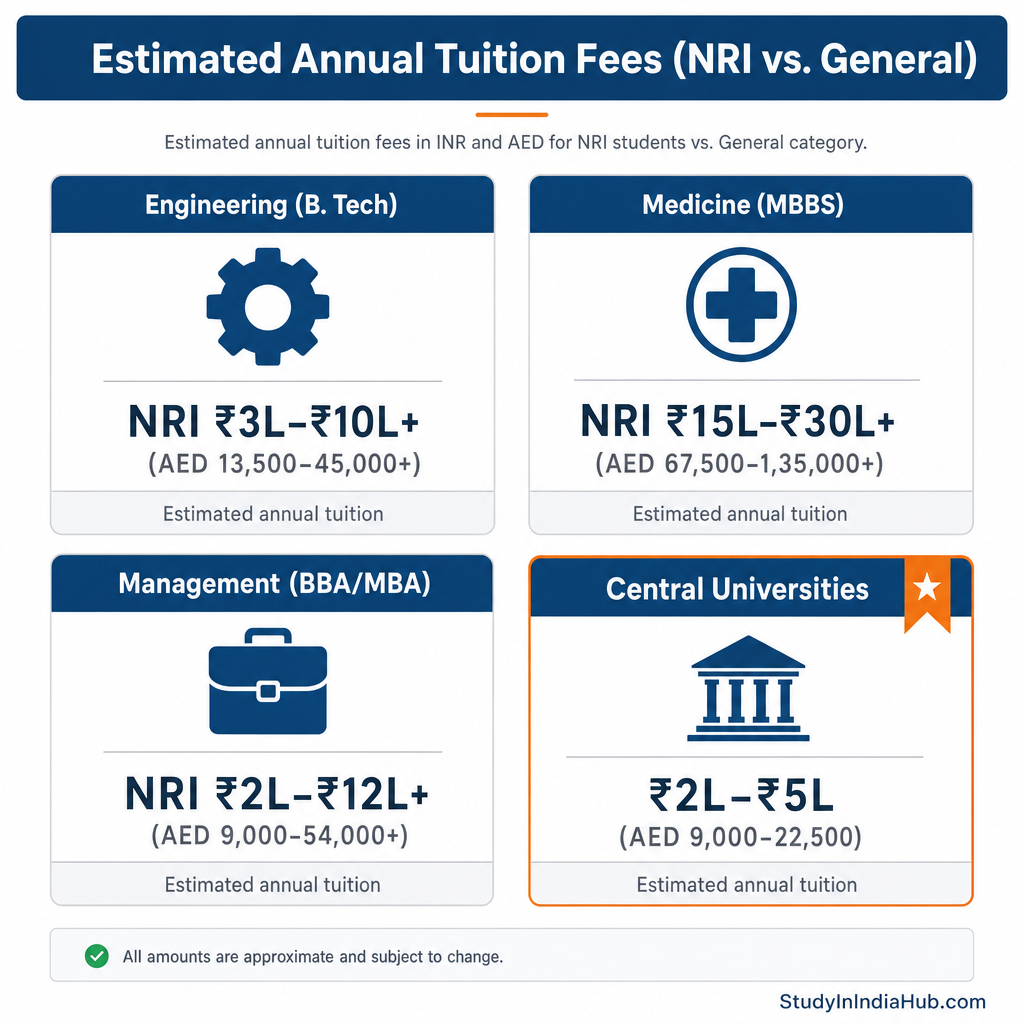
| Course Type | General Merit (INR/year) | NRI / Management Quota (INR/year) | Approx. AED (NRI rate) |
|---|---|---|---|
| Engineering (B. Tech) | ₹1,00,000 – ₹5,00,000 | ₹3,00,000 – ₹10,00,000+ | AED 13,500 – 45,000+ |
| Medicine (MBBS) | ₹5,00,000 – ₹10,00,000+ | ₹15,00,000 – ₹30,00,000+ | AED 67,500 – 1,35,000+ |
| Management (BBA/MBA) | ₹1,00,000 – ₹8,00,000 | ₹2,00,000 – ₹12,00,000+ | AED 9,000 – 54,000+ |
| Central Universities | ₹2,00,000 – ₹5,00,000 | ₹2,00,000 – ₹5,00,000 | AED 9,000 – 22,500 |
Sources: Study in India, UGC, NCHMCT direct admission rules.
How I Applied: The Admission Process Step by Step
I started where you probably are right now — the Indian Embassy in Abu Dhabi and the Consulate General in Dubai. Those websites give you the official framework. However, they do not give information about which universities actually welcome international applicants. For that, I dug through university websites, Study in India (SII) Portal, UAE-India student Facebook groups, Reddit threads, and a few NRI-quota agents in Karama.
The Karama Agents: Honest Take
The agents in Karama vary a lot. The ones who actually helped did two things: they figured out which portal route applied to my target university, and they checked whether my documents matched the university's exact wording. That was genuinely useful. The ones who just wanted commission created false urgency and spoke in vague generalities. They never gave me a written document requirement.
If an agent can't point you to the specific university page, that's not help — it's a fee for a conversation that goes nowhere. Any legitimate Karama agent will typically charge a flat service fee upfront (typically AED 1,500–3,000) and give you the university's direct admissions email so you can verify everything yourself. On the other hand, agents who won't reveal the specific university contact, who push only one or two institutions they're commissioned on, or who ask for full tuition payment through their own account are the ones I would stay from. The real value a legitimate agent adds is in navigating document attestation at the Indian Consulate, MOFA, and Apostille. If you're comfortable with portals and your documents are straightforward, you probably don't need an agent. But, if your credentials are non-standard or you need visa help as a non-Indian passport holder, a reliable one can save you a lot of stress.
For 2027 NRI Applicants: What to Do Now
- Shortlist 5–7 universities from official websites
- Confirm the route for each university — SII portal or direct
- Have your documents ready by June–July 2026 for next year's 2027 intake
- Get your offer letter first - Start applying and wait for your admit decision
- Use agents only for clarification, never as your primary source
Once, you have the admit, pay your admission fees. As an NRI you do not need a Visa or FRRO registration. You can just plan to come to India based on your university's requirement.
Travel and first week
The flight is the easy part. Dubai and India are both key travel hubs with a lot of daily flight options. DXB or SHJ to Mumbai, Bangalore, Hyderabad, or Delhi. Around 3 hours, about $200. Air India has one-way economy fares from Sharjah to Mumbai starting at AED 495. Air Arabia shows round-trip fares ranging from AED 839 to AED 871.

What actually happens in the first seven days:
- Get the SIM card first; everything else can wait. Pick up Jio or Airtel at the airport before you exit the terminal. You need it for Uber, hostel WiFi, the college WhatsApp group, and calling home. Don't put it off. You do not need other documents if you have your Indian passport. For non-Indian passport holders, you will need your residency proof from hostel before getting your SIM card.
- Hostel check-in- Print your admission letter.
- Bank account — open a student account once you have proof of your local address.
Is Indian Education Recognized in UAE and Kuwait?
Yes. Degrees from India are recognized in both countries. But recognition is institution-specific, not blanket. The employer or licensing authority will ask for proper verification. Degrees from leading universities (Delhi University, University of Mumbai) and premier institutions (IITs, NITs) clear Gulf recognition with little friction. Check your institution's NAAC grade through the NAAC Accreditation Results database. Private or deemed universities can sometimes require extra steps, particularly for recognition in Kuwait.
The Attestation Trail You Must Follow
- State HRD Attestation — confirmation from your state's Higher Education Department
- MEA Certification — stamp from India's Ministry of External Affairs
- Embassy Legalization — the UAE or Kuwait Embassy in India authenticates the MEA stamp
- Gulf-side Recognition — UAE's MOE equivalence, or Kuwait's MOHE authorization
| Country | Recognition Authority | Key Requirement |
|---|---|---|
| UAE | Ministry of Education (MOE) | DataFlow verification + MOE equivalency |
| Kuwait | Ministry of Higher Education (MOHE) | Cultural Office approval + HRD/MEA stamps |
Common Mistakes to Avoid
Overlooking Equivalence and Eligibility Requirements
Many students from the UAE and Kuwait assume their CBSE, British, or American curriculum results will be accepted without question. They won't. If you studied under a non-Indian board, you need an AIU Equivalence Certificate. Some universities require it before they'll even issue an offer letter. Start early. AIU verification can take 4–6 weeks.
Submitting Incomplete or Improperly Attested Documents
One missing attestation can hold up your entire application. Get your transcripts, birth certificate, and passport copies notarized by the UAE/Kuwait Ministry of Foreign Affairs and the Indian Embassy before you submit. Keep at least three sets of certified photocopies and scanned PDFs in cloud storage. You'll need them again for the visa, hostel, and FRRO registration (non-Indian passport holders only).
Missing Application or Student Visa Deadlines
Students regularly underestimate how long the student visa process takes once admission is confirmed. Indian student visas can take 2–4 weeks. FRRO registration must be completed within 14 days of arrival. Build a timeline that counts backward from your course start date. Submit your visa application the moment you have your admission letter and bonafide certificate.
Frequently Asked Questions
Do I need a student visa if I hold an Indian passport?
No. Indian passport holders don't need a student visa, regardless of where they live. OCI (Overseas Citizen of India) cardholders can also study without a student visa, though some institutions classify them under the NRI quota for fees. PIO and OCI holders should carry their cards alongside their foreign passport when entering India.
What is FRRO registration and when do I need to complete it?
FRRO (Foreigner Regional Registration Office) registration is mandatory for any non-Indian student only whose visa is valid for more than 180 days. Register at the nearest FRRO office within 14 days of arrival in India, even if your visa hasn't been "activated" yet. Missing this can result in fines starting from $30 and complications during future extensions.
How long does the Indian student visa process take from the UAE or Kuwait?
Standard processing through the Indian embassy in Abu Dhabi, Dubai, or Kuwait City typically takes 7–15 working days once all documents and the admission letter are submitted (Embassy of India, Kuwait). During peak season (June–August), delays of up to 4 weeks are common. Apply 6–8 weeks before your course start date. Tatkal processing isn't available for student visas.
What is the difference between NRI-quota fees and full international fees?
NRI-quota seats are reserved for Non-Resident Indian passport holders and OCI cardholders. Fees are usually 2–3 times higher than regular Indian student fees, paid in INR. Full international ("foreign national") fees apply to non-Indian passport holders, are quoted in USD, and are often 1.5–2 times higher than NRI fees. Confirm your category with the university before paying.
Will my IB Diploma or British A-Levels be recognized without AIU equivalency?
No. For most Indian universities you need an AIU equivalency certificate before your application is treated on par with CBSE/ICSE marks. Without it you fall into the general merit pool and lose NRI-quota eligibility, start the process at least three months before applications open.
Sources
- CIC News
- Study in India Portal
- Consulate General of India, Dubai
- Indian Visa Online
- AIU Equivalence Division
- Panjab University's official guidelines confirm NRI status on exactly this basis
- Indian Visa Online portal
- 25% supernumerary seats exclusively for international students
- UGC
- NCHMCT direct admission rules
- Nirma
- Savitribai Phule Pune University (SPPU)
- Air Arabia
- MakeMyTrip
- Compiled Hyderabad estimate
- Compiled Pune estimate
- nobroker.in
- wise.com
- NAAC Accreditation Results database
- University of Hyderabad
- Embassy of India, Kuwait
- ICCR scholarships